
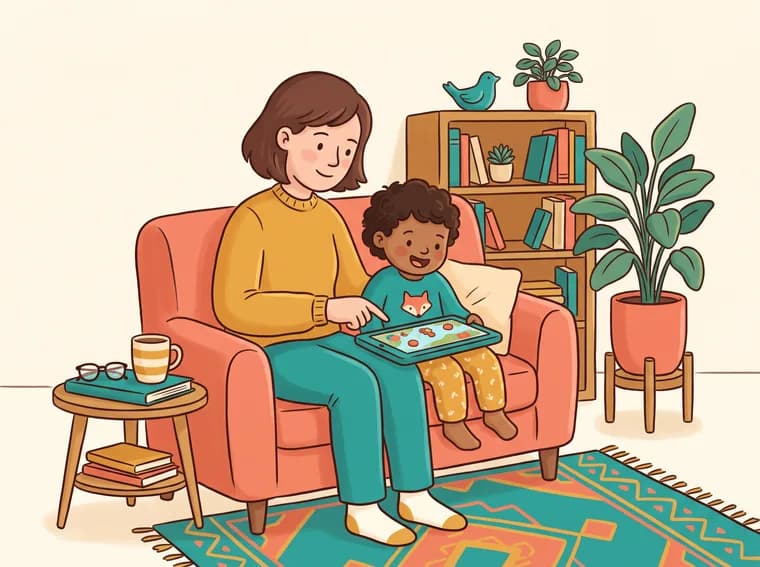
Healthy screen time for kids has less to do with the number on the timer and more to do with two questions: what is actually on the screen, and who is sitting nearby. Twenty focused minutes spent building, drawing, reading or solving something will almost always do more for your child than an hour of passive scrolling. So before you police the minutes, look hard at the content and the company — that is where the real difference lives.
The reason is simple. A screen is just a window; what matters is what your child is doing through it. Creating, deciding and problem-solving switch on an active, engaged brain, while an endless feed of auto-playing clips asks almost nothing of them. Two children can each spend half an hour on a tablet and come away with completely different experiences — one proud of something they made, the other foggy and a bit grumpy.
Quality screen time is about what and who
When parents search for quality screen time, they are usually really asking which activities are worth it. A good rule of thumb: favour screens that make something come out — a drawing, a solved puzzle, a finished sentence, a little tune — over screens that only pour something in. The best educational apps for children are the ones your child has to act on, not just watch. If they can end a session with nothing they chose and nothing to show, it was probably closer to scrolling than learning.
Then there is the who. Sit close for the first few minutes of whatever your child opens. A genuine "Ooh, what are you making?" turns a solo activity into a shared one, and quietly signals that this is something you value enough to watch. You do not have to hover for the whole session — those first few minutes are what matter, because they set the tone and let you see what the app is really asking of your child.
Set the finish line before you start
Most screen-time battles are really endings gone wrong. The fix for calmer screen time limits is to agree the finish line out loud before the screen goes on, not after. Try a four-step rhythm: name the activity ("the puzzle game"), name the end ("two levels, then we're done"), ask your child to say it back to you, and let a visible timer or the natural stopping point do the rest. When the ending was a plan you both made, "turn it off" stops being an ambush.
The most common mistake is making the limit about time a child cannot feel — "fifteen more minutes" means very little to a six-year-old in the middle of a level. Endings tied to the activity ("finish this build, then we stop") land far better than endings tied to the clock, because a child can actually see them coming. Another trap is springing the end with no warning; a simple one-minute heads-up ("last level now") prevents most of the meltdowns that give screen time without tantrums its name.
Make it a rhythm, not a running battle
Once the content is good and the ending is agreed, screens become far less of a daily negotiation. Pick one or two apps your child genuinely learns from, decide together when they happen — say, after dinner but before the bedtime story — and let the routine carry the weight instead of your willpower. A product like KAVI is designed for exactly this kind of short, active, finishable session, but the principle holds whatever your child uses.
None of this means screens are the enemy, or that every minute has to be educational. A bit of pure fun is part of childhood too. The goal is simply that the time counts — that your child more often than not comes away having made, solved or discovered something, and that switching off feels like the end of a plan rather than the start of a fight.