
The honest answer to how to raise a reader is almost too simple to believe: children become readers when they fall in love with books first, and get good at them second — not the other way round. Drills and flashcards can teach a child to decode words, but they rarely build a reader. The one who begs for "one more page" is the one still reading at fifteen. So your real job at home isn't to teach; it's to make the book the warmest, most wanted part of the day.
Here's the plain why. Reading is a habit before it is a skill, and habits grow from repetition and good feelings, not from pressure. When reading feels safe, cosy and chosen, a child's brain quietly files it under "things I love." When it feels like a daily test, it gets filed under "things I have to survive." Every one of the reading habits for kids below is really just a way of staying on the right side of that line.
Five tiny daily habits that build a reader
First, let them choose the book — even if it's the same one for the hundredth night. Repetition is how a young brain masters a story: the words turn predictable, your child starts "reading" along from memory, and that first taste of fluency feels wonderful. Choice is also how they learn that books belong to them, not only to school.
Second, keep it short and keep it daily. Ten unhurried minutes every evening beats an hour once a week, because a bedtime reading routine works precisely by being expected. Attach it to something that already happens — teeth, pyjamas, lamp down low, book — and you skip the nightly negotiation about whether reading happens at all.
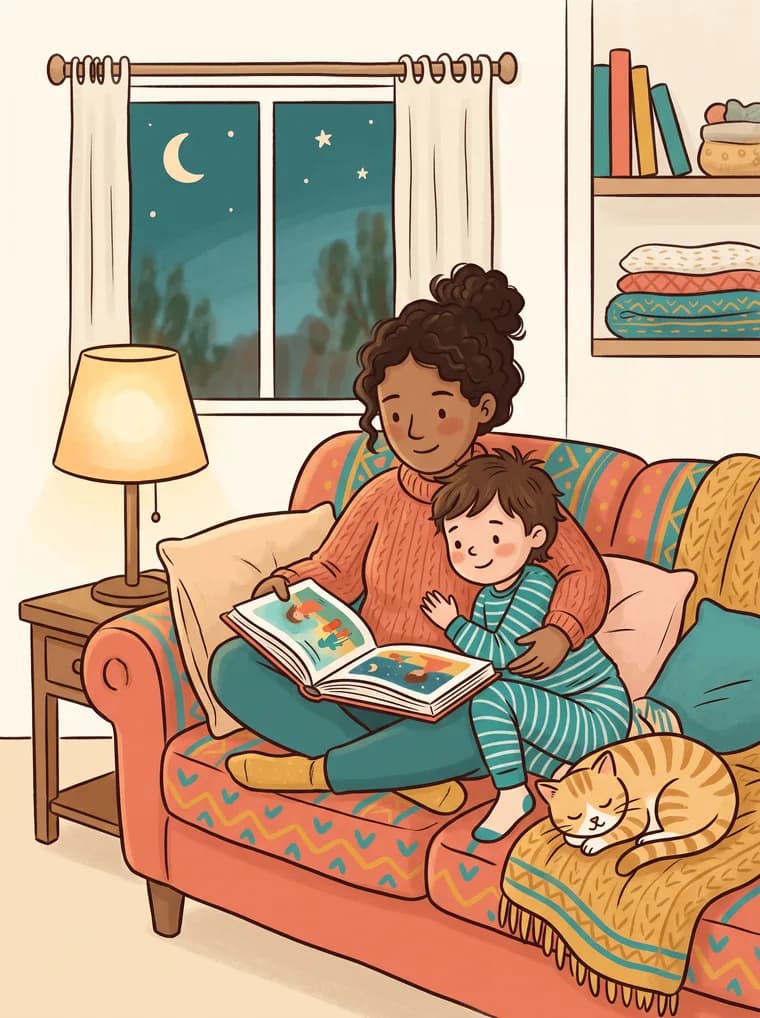
Third, make it the cosiest moment of the day. Dim the light, pull the blanket up, let them lean on you. You want your child's body to tie books to warmth and closeness, so that the feeling of being read to becomes something they chase for the rest of their lives.
Fourth, stop while they still want more. It is tempting to push for one more chapter when they're enjoying it, but leaving a little appetite is exactly what pulls them back to the book tomorrow. End on a cliffhanger, close the cover, and let the wanting do the work.
Fifth, let them catch you reading. Children copy what we do far more than what we tell them, so a parent curled up with their own book — phone face-down — is one of the most persuasive reading lessons there is. Say it out loud now and then: "I can't wait to get back to my book tonight."
The common mistake that puts children off
If you have ever typed "how do I get my child to read" into a search bar at 9pm, you have probably been told to drill harder. Usually the opposite helps. The quickest way to put a child off is to turn every page into a quiz — stopping mid-story to ask what sound a letter makes, or correcting every small stumble. That drags reading out of the pleasure column and into the work column. Talk about the story by all means — "why do you think she did that?" — but keep the decoding practice for another time of day. At bedtime, let the book just be a story.
Early literacy tips you can start tonight
You don't need a programme or a shelf of levelled readers. A handful of early literacy tips carry almost all the weight: read aloud daily, run your finger under the words now and then so print and sound connect, point out letters and signs out in the real world, and chat about the pictures as much as the text. None of it looks like teaching, and all of it is.
Tonight, try this exact sequence. One, let your child choose the book, with no veto. Two, read it the way they want it — silly voices and all. Three, pause once on a favourite page and wonder aloud: "What do you think happens next?" Four, stop a page or two before they're ready, and promise the rest tomorrow. Do that most nights and you are, quietly, raising a reader.
Some evenings the story can carry a little learning too — a shared app like KAVI can turn five minutes into a game your child asks for — but it will never beat your voice, your lap, and the same beloved book, chosen again. Keep the habits tiny, keep them daily, and let the love come first.